ChatGPT skills are becoming career currency in 2026.
But the people rushing to memorize prompts may be missing the bigger shift.
Employers are not looking for workers who can “ask AI better questions.” They are looking for workers who can use AI to produce better work, faster.
ChatGPT Skills for Jobs in 2026
As ChatGPT becomes a must-have workplace tool in 2026, many job seekers are focusing on the wrong skills. In this article, I explain why employers care less about memorized prompts and more about AI workflow thinking, the ability to use ChatGPT to research, analyze, verify, organize, and produce real business outcomes.

George M
Author
Jun 6, 2026
5 min read
For the past two years, “prompt engineering” has been treated like the magic ticket. Learn the right wording. Use the right formula. Add a role, a task, a tone, and a format.
That still matters.
But it is no longer enough.
The real ChatGPT skill for jobs in 2026 is AI workflow thinking.
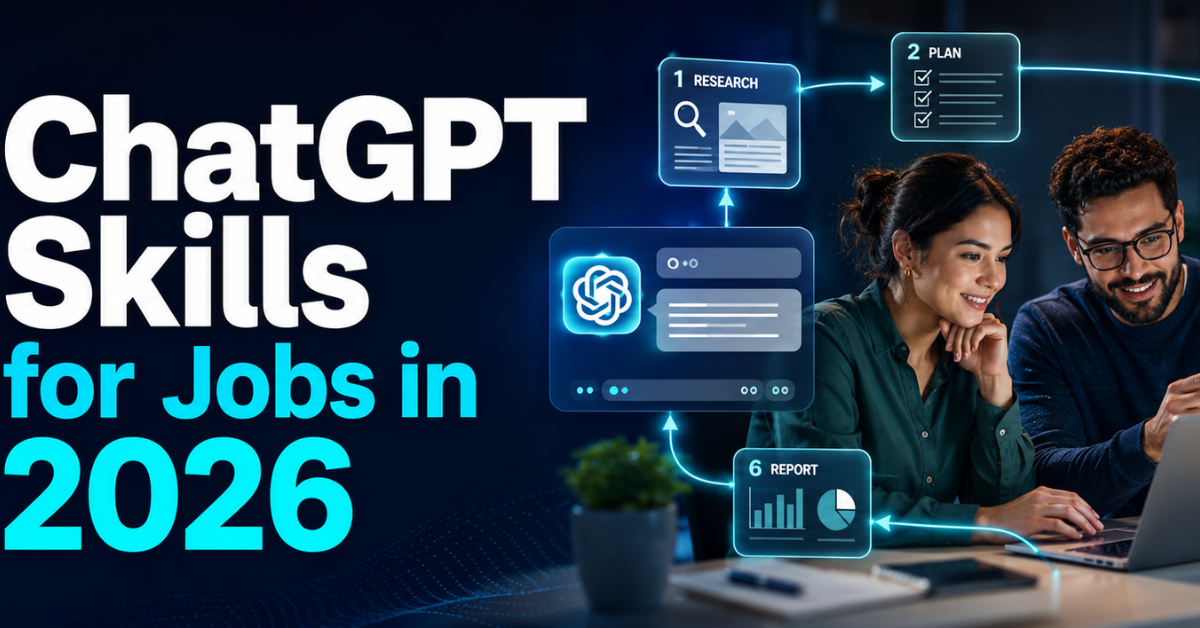
That means knowing where ChatGPT fits inside actual work: researching, planning, drafting, analyzing, checking, improving, documenting, and handing off results. It is not about one clever prompt. It is about turning messy work into a repeatable system.
And that is where most people get it wrong.
A job seeker might write “proficient in ChatGPT” on a resume. But what does that prove? Almost nothing. Anyone can open a chatbot and ask for help writing an email.
The stronger candidate says something different.
“I use ChatGPT to analyze customer feedback, group complaints by theme, draft response templates, and create weekly insights for the sales team.”
That sounds like work.
That sounds measurable.
That sounds useful.
Now this is where it gets interesting.
The World Economic Forum’s Future of Jobs Report 2025 found that technology skills, AI, big data, analytical thinking, and creative thinking are among the major skill areas shaping work through 2030. It also projected major job disruption, with both new roles created and existing roles displaced as technology changes work.
That means the safest workers are not simply the ones who “use AI.”
They are the ones who can combine AI with judgment.
ChatGPT can draft. But can you tell whether the draft is strategically useful?
ChatGPT can summarize. But can you decide what matters?
ChatGPT can analyze a spreadsheet and uploaded files, answer questions about data, and create tables or charts when useful. But can you ask the right business question before the analysis starts?
That is the difference.
In 2026, the valuable skill is not prompting. It is directing.
Companies do not promote people for generating more text. They reward people who reduce confusion, speed up decisions, and make work easier for everyone else.
A marketing assistant who uses ChatGPT to write captions is replaceable.
A marketing assistant who uses ChatGPT to compare campaign performance, identify weak messaging, generate test ideas, and brief the creative team is harder to ignore.
A customer support worker who uses ChatGPT to make replies sound nicer is helpful.
A support worker who uses ChatGPT to spot recurring product issues, build a knowledge base, and reduce repeat tickets is valuable.
A finance analyst who uses ChatGPT to explain formulas is learning.

A finance analyst who uses ChatGPT to clean data, test assumptions, write commentary, and prepare charts for leadership is operating at a higher level.
A confident AI-generated answer can still be wrong, shallow, outdated, or irrelevant. This is why verification is becoming one of the most underrated job skills. Workers who blindly paste AI output will create risk. Workers who can check sources, test claims, compare outputs, and refine the result will stand out.
That is why “AI literacy” is moving beyond tool usage.
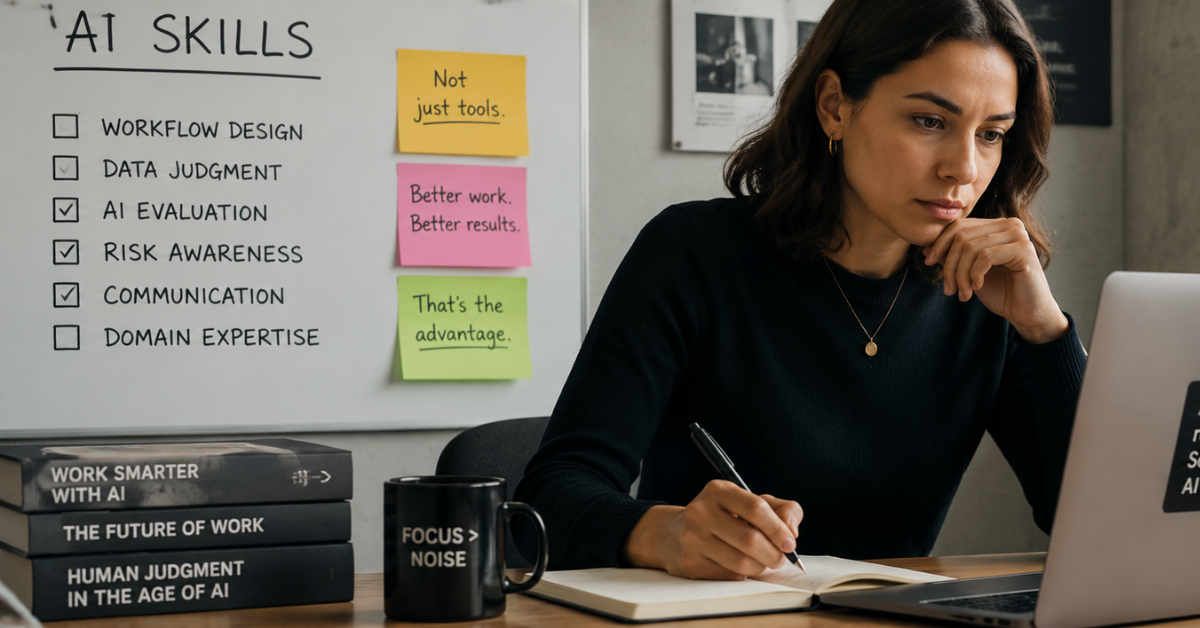
The best workers will know five things:
They will know how to break a task into steps.
They will know what to delegate to ChatGPT and what to keep human.
They will know how to check the output.
They will know how to turn the answer into a document, decision, chart, email, pitch, or process.
And they will know when not to use AI at all.
This matters even more because AI is no longer just a side tool. Microsoft’s 2025 Work Trend Index described a shift toward “Frontier Firms,” where humans work alongside AI agents and digital labor becomes part of how teams operate. That changes the career question.
The question is no longer: “Can you use ChatGPT?”
The question is: “Can you manage AI-assisted work?”
That is a much bigger skill.
It means a project manager may need to design an AI-supported reporting workflow.
A teacher may need to create lesson materials while checking accuracy and originality.
A recruiter may need to screen information faster without outsourcing judgment.
A freelancer may need to use ChatGPT to learn quickly, pitch better, and deliver more polished work. Freelancers are increasingly using generative AI for learning and market survival, but still face challenges around reliability, context, and proving those skills to clients.
This is where job seekers should pay attention.
Saying “I know ChatGPT” will not be impressive for long.
Showing what ChatGPT helped you produce will be.
A better resume bullet is not: “Used ChatGPT for productivity.”
It is: “Built an AI-assisted reporting process that reduced weekly manual analysis and produced client-ready summaries.”
A better interview answer is not: “I use AI to save time.”
It is: “I use ChatGPT as a first-pass research and drafting partner, then verify the output, adapt it to the business context, and turn it into something the team can act on.”
That is the skill employers want.
Not prompt tricks.
Not AI hype.
Not pretending the tool does everything.
The people who pull ahead in 2026 will be the ones who treat ChatGPT like a work system, not a shortcut.
Because the future of work will not belong to people who ask the best prompts.
It will belong to people who know what to do with the answers.
About the Author
George M
Author
George M. is a hands-on developer, architect, and technology writer with a focus on practical applications of modern tech stacks. He holds a B.S. in Computer Science and is a certified specialist with a Google Cloud ML certification. George actively contributes to the open-source community via GitHub.