AI is no longer just a bonus skill. In 2026, employers are looking for workers who can use AI to improve real work, not just generate quick answers. This article explains why prompt writing is only the beginning — and why skills like workflow design, AI evaluation, data judgment, risk awareness, and domain expertise are becoming essential for career growth.
George M
Author
Jun 4, 2026
5 min read
Why AI Skills Are Becoming the New Career Filter
Everyone is trying to “learn AI” right now, but many are learning the smallest part of it.
That is the uncomfortable shift happening in 2026: employers are no longer impressed by someone who can ask ChatGPT a decent question. They want people who can use AI to make work faster, smarter, safer, and more valuable.
The truth is, AI skill is becoming less about tools and more about judgment.
The World Economic Forum’s Future of Jobs Report 2025 found that technology, economic uncertainty, demographic change, and the green transition are reshaping work through 2030, based on input from more than 1,000 global employers representing over 14 million workers. LinkedIn’s Work Change Report also says that by 2030, 70% of the skills used in most jobs will change, with AI acting as a major catalyst.
That means the question is no longer, “Can you use AI?”
The better question is: “Can you work better because of AI?”
The problem is, a lot of people are treating AI like a shortcut machine. They use it to write emails, summarize documents, create slides, or polish resumes. Useful? Yes. Career-changing? Not necessarily.
Employers are starting to look past basic AI usage because everyone can do it. The value is shifting to people who can connect AI to real business outcomes.
That is why one of the most important AI skills in 2026 is workflow thinking.
Most important AI skills in 2026 is workflow thinking.
This means looking at a task and asking: Where is time being wasted? What could be automated? What still needs human review? What should never be handed fully to AI?
A marketing assistant who uses AI to write captions is replaceable.
A marketing assistant who builds a repeatable system for campaign research, audience testing, content drafts, performance analysis, and brand-safe review is much more valuable.
Same tool. Different skill level.
Now this is where it gets interesting.
Employers are also looking for people who can manage AI agents, not just use AI chatbots. Microsoft’s 2025 Work Trend Index describes a workplace shift in which AI first acts as an assistant, then agents join teams as “digital colleagues,” handling specific tasks under human direction.
That changes the skill set.
The employee of 2026 may not just complete tasks. They may assign tasks to AI, check the output, improve the process, and decide what gets escalated to a human.
That requires clear communication, process design, verification, and accountability.
So, employers want people who can be good managers of machines.
The more AI enters the workplace, the more valuable human judgment becomes. AI can produce confident nonsense. It can miss context. It can create legal, privacy, brand, or security risks. It can make weak work look polished.
So another top AI skill is AI evaluation.
Can you tell when an answer is wrong? Can you spot a fake source? Can you check whether a recommendation makes sense? Can you compare AI output against company policy, customer needs, or real data?
This is where many workers get it wrong. They think speed is an advantage.
Employers care about speed, but they care even more about reliable speed.
A finance analyst who uses AI to generate a forecast still needs to understand the assumptions. A recruiter who uses AI to screen candidates still needs to watch for bias. A customer support lead who uses AI to draft replies still needs to protect tone, accuracy, and trust.
The winners are not the people who blindly trust AI.
The winners are the people who know when not to.
Another skill rising fast is data fluency.
This does not mean everyone needs to become a data scientist. But workers need to understand how data feeds AI decisions. They need to know what clean data looks like, what bad data can ruin, and why private company information cannot be pasted into random tools.
A sales manager who can use AI to analyze customer objections has an edge.
A sales manager who understands whether the data is complete, current, and relevant has a bigger edge.
That is the difference between using AI and using AI responsibly.
The final skill employers want is the one people underestimate most: domain expertise.
AI is powerful, but it is not a substitute for knowing the job.
A lawyer using AI still needs legal judgment. A nurse using AI still needs clinical understanding. A teacher using AI still needs classroom instincts. A product manager using AI still needs customer insight.
AI makes strong professionals stronger. It does not magically turn weak understanding into expertise.
That is why the best AI skill stack for 2026 looks like this:
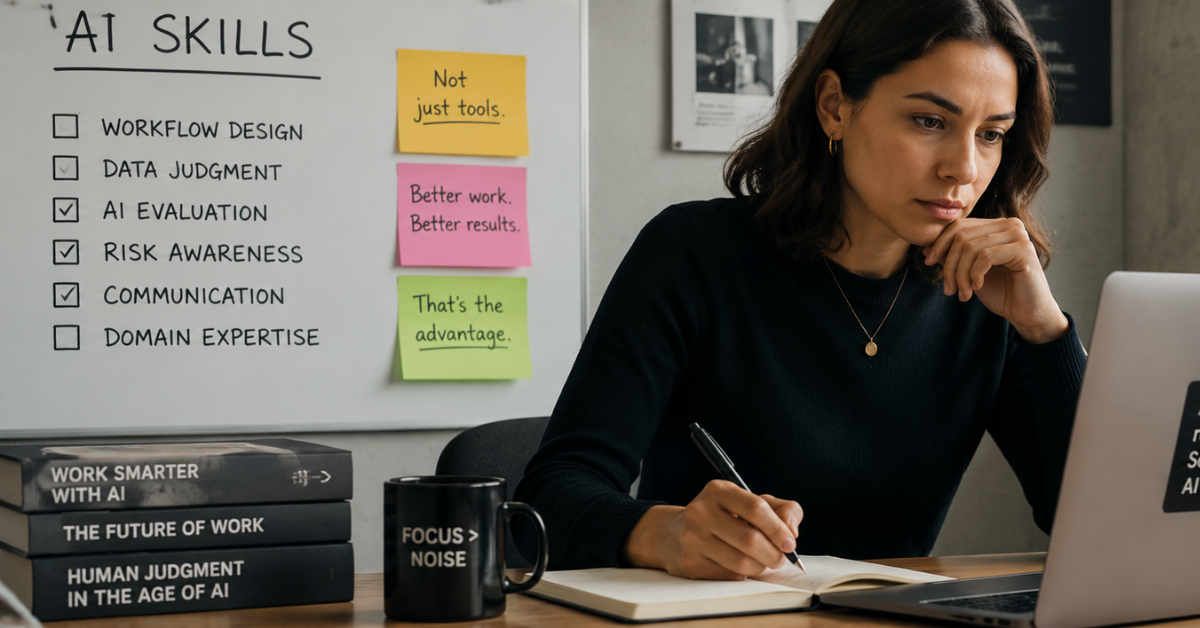
AI fluency, workflow design, data judgment, risk awareness, communication, and deep knowledge of your field.
Not just prompts.
Not just certificates.
Not just saying “I use AI” on a resume.
There is evidence that AI skills already influence hiring. A 2026 hiring experiment with 1,700 recruiters in the UK and US found that AI skills increased the probability of receiving interview invitations by about 8 to 15 percentage points across roles, including office assistant, graphic designer, and software engineer.
That is the opportunity.
AI skills can make you more visible. But only if they look practical, credible, and connected to work that employers actually need done.
The smartest move in 2026 is not to learn every new AI tool.
It is to pick one part of your job and become the person who can redesign it with AI.
Make the reporting faster. Make the research sharper. Make the customer response better. Make the hiring process cleaner. Make the content workflow more consistent. Make the risk review stronger.
That is what employers want.
Not someone who plays with AI, but someone who can turn AI into better work.
About the Author
George M
Author
George M. is a hands-on developer, architect, and technology writer with a focus on practical applications of modern tech stacks. He holds a B.S. in Computer Science and is a certified specialist with a Google Cloud ML certification. George actively contributes to the open-source community via GitHub.