The remote work revolution has reached a turning point. Over 43 million digital nomads worldwide now contribute approximately $940 billion annually to the global economy, according to recent data. This isn't a temporary trend anymore; it's a fundamental restructuring of how work happens. More than 56 countries now offer dedicated digital nomad visas, up from just 12 in 2020, and they're competing aggressively for your remote income.
Countries Best for Remote Workers in 2026
With 56 countries now competing for remote workers, the decision isn't about finding the "best" destination, it's about understanding where your income level, tax situation, and work style actually align.

George M
Author
May 7, 2026
17 min read
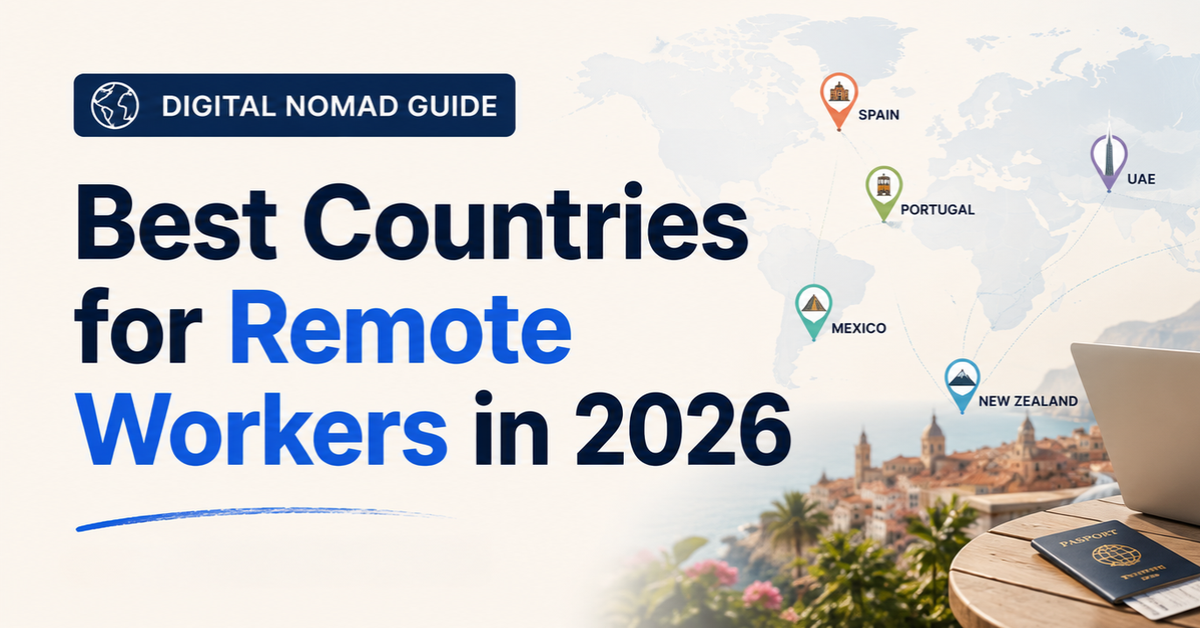
The "best" country for remote work is wherever your income level, client time zones, tax situation, and tolerance for bureaucracy happen to align.
The decision has become more complex precisely because the infrastructure has matured. The grey area era is over. Countries like Spain, Portugal, and the UAE have tightened enforcement on tourist visa workarounds, and getting caught working on the wrong visa now carries real consequences, including fines, deportation, and future entry bans. What that means for you is simple: you need the right visa, and you need to understand what you're actually signing up for.
The 2026 Remote Work Landscape
The explosion in digital nomad visa programs reflects genuine global competition for skilled workers. Between 2020 and 2026, remote work participation doubled, with approximately 52% of the global workforce now working remotely at least part-time. Governments quickly realized that remote workers spend money locally without competing for domestic jobs, making them economically attractive. Slovenia launched its program in late 2025. Italy's Lavoratore da Remoto visa became fully operational in early 2024. Spain has issued nearly 32,000 visas since January 2023, with applications up 40% year-over-year.
What changed isn't just the number of options available. It's the quality of those options and the seriousness with which countries enforce them. Digital nomad visas have shifted from novelty permits to legitimate immigration pathways, complete with renewal options, residency tracks, and in some cases, tax incentives that can save you tens of thousands of dollars annually.
This maturation comes with expectations. Income requirements typically range from $900 to $5,000 monthly, depending on the country. Health insurance is almost always mandatory. And most programs require at least 80% of your income to come from foreign sources, meaning you can't take local jobs or clients without violating your visa terms.
Top Countries for Remote Workers in 2026
Spain

Spain has become Europe's benchmark for digital nomad programs. The country holds the top spot in the Global Digital Nomad Visa Index with a near-perfect score, and for good reason. Spain's visa, launched under the 2022 Startup Act, requires a minimum monthly income of €2,849 (200% of Spain's 2026 minimum wage), with at least 80% of that income coming from non-Spanish sources.
The real draw is the Beckham Law, which taxes qualifying nomads at a flat 24% rate on Spanish-sourced income for up to six years, while foreign income is taxed at 0%. For high earners, this represents significant savings. The visa starts as a one-year permit if you apply at a consulate, but if you apply in-country through the UGE, you receive a three-year residence permit directly, which is renewable and creates a path to permanent residency after five years.
Spain works best for remote workers seeking long-term stability in Europe, those who can benefit from the tax advantages, and people drawn to vibrant cities like Barcelona, Madrid, Valencia, or Seville. The application process now takes two to three months at US and UK consulates due to high demand, so plan accordingly.
Portugal
Portugal has long been a go-to destination for digital nomads, and it remains one of the most appealing countries in Europe for remote workers in 2026. The D8 Digital Nomad Visa allows non-EU citizens to live in Portugal while working remotely for companies or clients based outside the country. The visa is valid for up to one year as a temporary stay visa, or you can apply for a two-year residence permit for long-term residence.
The income requirement has risen to €3,680 per month, four times the 2026 Portuguese minimum wage. This increase reflects Portugal's growing popularity and rising cost of living, particularly in Lisbon and Porto. The D8 visa can be renewed for up to five years and offers a path to permanent residency, making it attractive for those with long-term plans.
Portugal's Non-Habitual Resident tax program has been restructured in recent years, so you'll want to confirm current tax advantages with an advisor. The country appeals to remote workers who value safety, mild climate, welcoming culture, strong expat communities, and proximity to the rest of Europe.
New Zealand

New Zealand ranks in the Passportivity Digital Nomad Visa Index, and the reason is simple: accessibility. The country requires just $610 per month in income, the lowest threshold among developed nations offering digital nomad visas. Combine that with a very high level of safety, almost full internet coverage across the country, and English as an official language, and you have one of the easiest entry points for remote workers.
New Zealand offers stunning natural landscapes, outdoor recreation, and a high quality of life. The main trade-offs are geographic isolation, which means you're far from most other countries, and time zone challenges if your clients are based in Europe or the Americas. The cost of living, particularly housing, can also be higher than the low-income requirement suggests.
New Zealand works well for remote workers who prioritize safety, natural beauty, and outdoor activities, and who don't mind being far from other travel destinations.
United Arab Emirates
The UAE offers 0% personal income tax, making it one of the most tax-efficient destinations for remote workers globally. There's no local sponsorship requirement, and Dubai is the primary base for most digital nomads. The minimum income requirement is $3,500 per month. The UAE increased its bank statement requirement from three months to six consecutive months, a change that has caught many applicants off guard.
The UAE pairs zero taxation with strong infrastructure, exceptional safety, world-class transport systems, and a strategic location for those working with clients in Europe, Asia, or Africa. The cost of living is high, particularly for housing in Dubai, but the tax savings can offset this for higher earners.
The UAE suits high-income remote workers who prioritize tax optimization, luxury amenities, and a cosmopolitan lifestyle. It's less appealing for those seeking cultural immersion or affordable living.
Thailand
Thailand introduced a multi-entry Digital Nomad Visa in 2024 that allows up to five years of stay with 180-day intervals. The country has long been a favorite among remote workers for its affordable cost of living, fast internet, and cities like Bangkok and Chiang Mai that offer mature coworking scenes and large expat communities.
Thailand combines a tropical climate, incredible food, rich culture, and accessibility throughout Southeast Asia. The time zone works reasonably well for clients in Asia, Australia, and even Europe, though less so for the Americas. Healthcare is affordable and high-quality in major cities, and the cost of living allows for a comfortable lifestyle on $1,500 to $2,500 monthly.
Thailand is ideal for remote workers who want affordability, warm weather, cultural experiences, and a well-established digital nomad community. The visa's five-year option makes it viable for longer-term stays without constant renewals.
Colombia
Colombia offers the most financially accessible digital nomad visa worldwide, with a minimum income requirement of approximately $900 per month. The visa is renewable for one year, and cities like Medellín and Bogotá have become hubs for remote workers seeking affordability, vibrant culture, and improved infrastructure.
Medellín, in particular, has earned a reputation as a top remote-work destination thanks to its year-round spring-like climate, growing coworking spaces, and active expat community. The cost of living is low, with comfortable living possible on $1,200 to $2,000 monthly. That said, you'll learn quickly to have backup internet, backup power, and backup plans for your backup plans. Infrastructure can be inconsistent, particularly outside major cities.
Colombia works best for budget-conscious remote workers who prioritize affordability and cultural richness and who can tolerate occasional infrastructure hiccups.
Malta

Malta consistently ranks among the most balanced destinations for digital nomads. The country shows excellent results in safety, internet quality, and English-language use, as English is one of Malta's official languages. Malta's location in the Mediterranean provides easy access to Europe, warm weather, and a high quality of life.
The income threshold is comparatively high at €3,500 per month, which prices out many applicants. However, for those who qualify, Malta offers EU membership benefits, strong infrastructure, and a straightforward visa process. The small size of the island means you can explore the entire country easily, though it also means fewer options for variety in day-to-day life.
Malta appeals to higher-earning remote workers seeking EU access, excellent safety, reliable infrastructure, and an English-speaking environment, without the higher costs of countries like Switzerland or Luxembourg.
Estonia
Estonia has built its reputation as Europe's most tech-forward nation, and its Digital Nomad Visa reflects that positioning. The country's e-Residency program already attracts digital entrepreneurs, and the nomad visa offers a straightforward option for remote workers employed by companies outside Estonia.
Estonia provides excellent digital infrastructure, low bureaucracy, and a clear application process. Tallinn, the capital, offers a growing tech scene, coworking spaces, and a small but active expat community. The climate is cold, with harsh winters, which isn't for everyone. The cost of living is below Western European averages but above those in Southern or Eastern Europe.
Estonia suits tech-focused remote workers, particularly developers, designers, and founders, who value digital-first governance and minimal bureaucracy and don't mind the cold climate.
Poland
Poland combines EU stability with costs 40-50% below Western European averages. Cities like Krakow and Warsaw offer cultural richness, strong infrastructure, excellent food scenes, and increasingly good English proficiency among younger generations. The tech infrastructure is solid, and coworking spaces are widely available.
At the time of publication, Poland doesn't have a dedicated digital nomad visa, but it offers other residence permit options for remote workers, including freelance visas and business permits. The application process requires more research than countries with specific nomad programs, but the quality of life and cost balance make it worth considering.
Poland works well for remote workers who want European culture and infrastructure without the price tag of France, Germany, or the Netherlands, and who don't mind slightly more complex visa processes.
Malaysia
Malaysia stands out in the Passportivity Digital Nomad Visa Index as one of the most practical options for remote workers. Kuala Lumpur offers first-world infrastructure at developing-nation prices. The time zone works well for both Asian and European clients, making it one of the best geographic positions for global remote work.
Malaysia's MM2H visa program has undergone changes that made it less accessible than before, but the country still offers strong value. The cost of living is low, English is widely spoken, the food scene is exceptional, and cultural diversity means you can find your community regardless of your background. Internet reliability is strong in major cities.
Malaysia appeals to remote workers seeking a balance of affordability, infrastructure, cultural diversity, and strategic time-zone positioning for global clients.
Mexico
Mexico's proximity to the US makes it one of the most practical options for American remote workers. Time zones align perfectly with US clients, you can maintain relationships without destroying your sleep schedule, and flights home are short and affordable. Cities like Mexico City, Playa del Carmen, and Guadalajara have thriving digital nomad communities.
The cost of living varies significantly by location. Mexico City offers urban energy, world-class food, and cultural richness at moderate costs. Beach towns like Playa del Carmen or Tulum offer tropical lifestyles but have become more expensive due to tourism and remote worker influx. Overall, comfortable living is achievable on $1,500 to $2,500 monthly.
Mexico suits US-based remote workers who need time zone alignment, want short travel distances home, and appreciate rich culture, excellent food, and warm weather.
Greece
Greece competes for remote workers by offering a 50% tax break to nomads who become Greek tax residents and commit to a two-year stay. The country offers a Mediterranean lifestyle, island-hopping opportunities, rich history, and improving infrastructure in cities like Athens and Thessaloniki.
The catch is the 183-day rule. Stay more than half the year, and Greece claims full tax residency, which may trigger employer social security obligations unless a tax treaty applies. The tax break is attractive, but you need to understand the full implications before committing.
Greece works for remote workers drawn to Mediterranean culture, a slower pace of life, and a warm climate, particularly those whose tax situations allow them to benefit from the 50% reduction.
Singapore
Singapore offers exceptional safety, connectivity, and a strategic location in the Asia-Pacific. The country ranks among the most stable and well-governed in the world, with world-class infrastructure, efficient public transport, and a cosmopolitan environment. English is widely spoken.
The main barriers are high housing costs and visa constraints. Singapore's visa requirements are more stringent than those of many countries, and the cost of living, particularly for accommodation, is among the highest globally. For remote workers who can afford it, Singapore provides a premium experience with zero compromise on infrastructure or safety.
Singapore suits high-earning remote workers who prioritize stability, safety, and infrastructure over affordability, and who want a base in Asia with excellent global connectivity.
Infrastructure: What Actually Makes a Location Work
Cost of living and visa accessibility mean nothing if you can't maintain productivity. Remote workers lose 30 to 60 minutes daily to internet problems, amounting to nearly 100 hours of wasted time annually. That's more than three full work weeks lost to frozen video calls, dropped connections, and troubleshooting sessions.
For smooth video calls, cloud-based collaboration, and file transfers, you need at least 100 Mbps download and 20 Mbps upload speed of dedicated bandwidth. Countries with strong digital infrastructure, such as Estonia, Singapore, and Spain, rarely experience connectivity problems. But in places like Colombia or Vietnam, where the cost of living is incredibly attractive, you quickly learn to have backup internet, backup power, and backup plans for your backup plans. The savings look great on paper until Sunday afternoon arrives and you realize the internet has been out for six hours with no estimated repair time.
Time zone alignment matters more than most people anticipate. Mexico's proximity to the US means you can maintain client relationships across time zones without destroying your sleep schedule. Portugal and Spain work well for European and East Coast US clients. Malaysia sits in a sweet spot for both Asian and European time zones. If you're constantly working night shifts to accommodate client meetings, the lifestyle benefits of remote work erode quickly.
Healthcare access deserves serious consideration. Portugal and Spain eventually open public healthcare once you become a legal resident and pay into the social security system, though that usually extends beyond the first-year nomad visa period. The UAE offers strong private healthcare, but at premium prices.
The Cost-of-Living Reality
Geographic arbitrage, the practice of earning in a strong currency while spending in a weaker one, works brilliantly until you factor in the hidden costs. A software engineer earning $75,000 annually can afford a three-bedroom apartment in central Lisbon while their colleague with the same salary shares a studio in San Francisco. That gap creates genuine lifestyle improvement. But the calculation shifts when you factor in the cost of loneliness.
Remote workers in the US save an average of $7,000 annually on commuting, lunches, and office-related expenses compared to their in-office counterparts, who spend around $863 monthly on work expenses versus $423 for remote workers. Scale that globally and the savings multiply. Living in Poland, Malaysia, or Colombia can reduce your expenses by 40-70% compared to major US or Western European cities, but if maintaining mental health requires flying home every two months, the math stops working.
The countries where your salary stretches furthest aren't necessarily the ones with the lowest cost of living. They're the ones where the gap between your earning currency and local spending power creates genuine lifestyle improvement without triggering the psychological tax of constant comparison. Portugal, Poland, and Malaysia top this category not because they're cheap, but because they offer infrastructure, community, and quality of life that make the financial advantage feel sustainable rather than exploitative.
Tax Implications You Can't Escape
Here's the part most digital nomad content glosses over: getting a visa doesn't eliminate your tax obligations. The 183-day rule serves as a threshold in most countries. Stay more than 183 days in a calendar year, and you typically become a tax resident, potentially liable for local income tax on worldwide earnings. The exact definition and threshold vary by country, so you need to verify the rules for your specific destination.
Americans face a unique challenge. The US taxes its citizens on worldwide income regardless of where they live. A "tax-free" nomad visa does not eliminate US tax obligations. The Foreign Earned Income Exclusion can exclude up to approximately $132,900 from federal income tax in 2026, and the Foreign Tax Credit offsets taxes paid abroad. Used strategically, these tools significantly reduce your effective rate. Used carelessly, or not at all, you pay twice.
Some countries offer genuine tax advantages. Spain's Beckham Law remains the headline perk for high earners. Greece's 50% tax break works for nomads committing to a two-year stay. The UAE's 0% personal income tax attracts freelancers and entrepreneurs, though the UAE quietly raised its bank statement requirement from three months to six months, catching hundreds of applicants off guard.
Tax laws change fast. Portugal's Non-Habitual Resident program, despite recent restructuring, still offers advantages that can offset higher living costs, but it's essential to confirm current details with a tax advisor before applying. This is not an area where you want to rely on outdated blog posts or assume your situation mirrors someone else's.
How to Choose Your Best Country
Stop looking for the universal winner. It doesn't exist. The decision framework requires honest self-assessment across several dimensions.
Match your income level to realistic programs. Don't apply for visas that require €3,500 per month if you earn $2,000. Look at the time zone overlap with your clients or employer. If you're working US East Coast hours from Southeast Asia, you'll be on calls regularly at 11 PM. Consider your tolerance for bureaucracy and language barriers. Some countries make visa applications straightforward; others require notarized documents, apostille stamps, and months of waiting.
Think about your need for community versus solitude. Cities like Lisbon, Barcelona, and Medellín have mature expat communities and coworking scenes. More remote locations offer tranquility, but can feel isolating. Be realistic about your long-term goals. Are you seeking permanent residency in the long term, or do you want the flexibility to move every year or two?
The smart approach is to try shorter stays before committing to visa applications. Spend a month or two in a place on a tourist visa to test internet reliability, explore neighborhoods, and gauge whether the lifestyle fits. Visa applications cost time and money. A rejected application can ban you from reapplying for a year in some countries.
Key Takeaways
The remote work landscape has matured dramatically, with 56+ countries now offering digital nomad visas, but the grey area era is over, and enforcement has tightened significantly.
The best country for remote work depends on what you're optimizing for: visa accessibility, tax benefits, cost of living, infrastructure quality, or long-term residency pathways. There's no universal winner.
Infrastructure matters more than cost alone. Reliable internet, time zone alignment, and access to healthcare and banking determine whether a location is sustainable in the long term, not just affordable.
Tax implications are unavoidable. The 183-day residency rule, territorial versus worldwide taxation, and your home country obligations, especially for US citizens, must be understood before relocating.
Geographic arbitrage works only when the financial advantage doesn't come with psychological costs like isolation, infrastructure failures, or constant visa uncertainty. The countries that truly work for remote professionals have solved the infrastructure puzzles while maintaining the quality of life.
About the Author
George M
Author
George M. is a hands-on developer, architect, and technology writer with a focus on practical applications of modern tech stacks. He holds a B.S. in Computer Science and is a certified specialist with a Google Cloud ML certification. George actively contributes to the open-source community via GitHub.