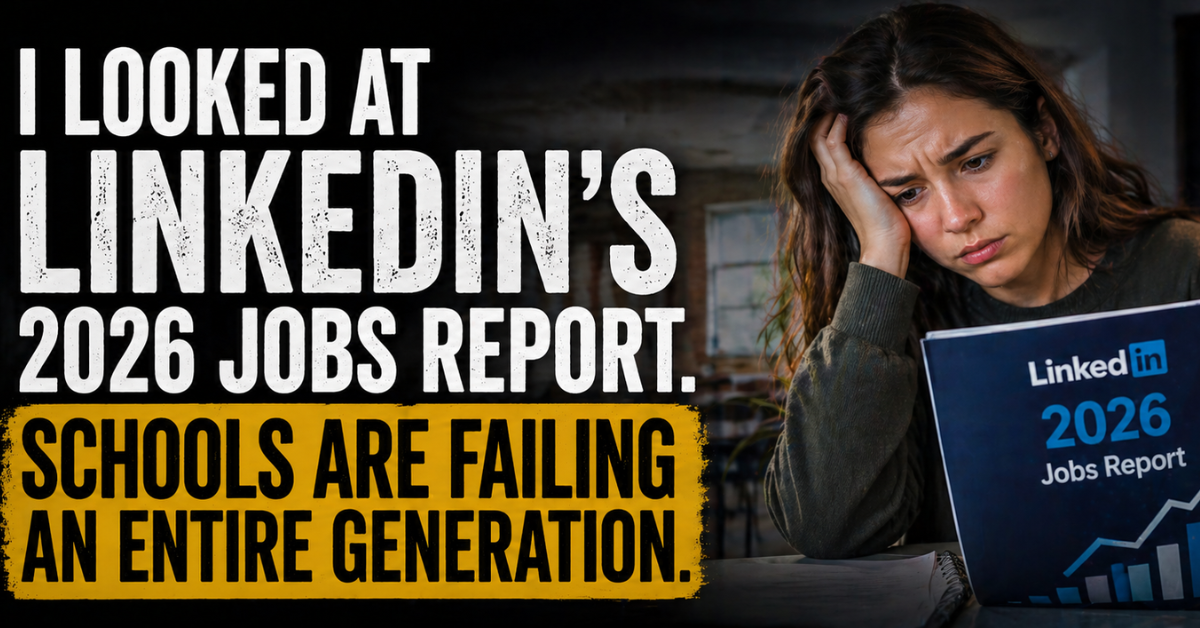
LinkedIn released its 2026 list of fastest-growing jobs. I spent an hour cross-referencing it with college curricula and vocational programs. The gap is staggering, and if you're relying on traditional education to prepare you for what's hiring, you're already behind.
I Looked at LinkedIn's 2026 Jobs Report. Schools Are Failing an Entire Generation
LinkedIn's 2026 jobs report shows the fastest-growing roles didn't exist in any curriculum five years ago. Prompt engineers are making six figures. MLOps specialists are growing by over 40% growth. Solar technicians can't be trained fast enough. Meanwhile, schools are still teaching for a job market that's vanishing. Here's the uncomfortable truth about why your degree isn't preparing you for what's actually hiring, and what the people landing these roles are doing instead.

George M
Author
Apr 26, 2026
4 min read
Here's what nobody's saying: the roles exploding right now didn't exist in any meaningful curriculum five years ago. Not as electives. Not as bootcamps. Nowhere.
Prompt engineering is LinkedIn's fastest-rising role. Companies are hiring specialists whose sole job is to write better questions for AI. Growth is double-digit, salaries hit six figures, and exactly zero universities offer a "Prompt Engineering 101" course. You either taught yourself, or you're not in the game.
Schools teach skills for a market that's vanishing while ignoring the one that's actually hiring.
The roles growing fastest aren't on any campus map
Take MLOps engineers, the people who bridge the gap between AI development and production. BLS projects 36% growth for Data Scientists through 2033, a rate that is 'much faster than average and directly fueled by the rising need to operationalize AI models.
But most computer science programs still teach classical programming, not machine-learning pipelines. The entire discipline of "AI operations" is learned through vendor certifications and on-the-job scrambling, not semester-long coursework.
Or AI interaction designers. These specialists design the way humans interact with chatbots and voice assistants. Upwork reports 70–300% year-over-year growth in conversational AI gigs. Design schools are still teaching visual UI. Dialog flows, intent mapping, containment rates, none of it's in the standard curriculum.
Here's where it gets worse: even the blue-collar opportunities are outpacing education.
Solar PV installers and wind turbine technicians are growing at 42% and 50%, respectively, per the BLS. Community colleges still emphasize fossil-fuel trades. Renewables training exists, but it's scattered, inconsistent, and nowhere near the scale of demand. We're building the energy transition with a workforce trained for the last century's grid.
The credential trap is getting worse
Traditional degrees promised you'd learn once and work for decades. But..
Cybersecurity engineers now need to understand AI-augmented threats, deepfakes, automated attacks, and AI-enabled fraud. Most cybersecurity tracks are still teaching network fundamentals from 2015. The industry is moving to "AI-first" security, and schools are stuck in pre-ChatGPT mode.
Even healthcare is splitting. Home health aides are projected to add 739,800 new jobs by 2034, but the role is shifting. It's no longer just manual caregiving; it's human workers using remote-monitoring apps, sensor data, and AI-assisted vital-sign tracking. Vocational training is still built around hospital-based care, not distributed tech-aided ecosystems.
This is the pattern: credentials lag behind reality by at least 3–5 years. By the time a program launches, the market has moved.
What nobody wants to admit
The fastest-growing roles share one thing: they're either too new for academia to touch or have emerged from industries that schools still treat as "non-traditional."
Sustainability and ESG specialists are in double-digit growth as investors demand climate-aligned reporting. Business schools treated this as a nice-to-have until about 18 months ago. Most practitioners retrained from finance or operations because no undergraduate track existed.
Workforce development managers, 'people building AI reskilling programs inside companies', are LinkedIn's breakout HR role. They design micro-credentials, skills-based career paths, and AI-literacy training. HR programs never taught "AI upskilling strategy" as a core competency. The entire function is being invented in real-time.
Even weirder, AI-augmented content creators are surging. Upwork reports 329% YoY growth in AI video-generation gigs. Film schools are still teaching manual editing and camera work, not text-to-video pipelines and prompt-based production.
The education system isn't just slow. It's structurally incapable of keeping up.
What this means for you
If you're waiting for your school to prepare you for what's actually hiring, you've already lost time.
The people landing these roles are:
Teaching themselves via YouTube, Discord communities, and vendor docs
Getting micro-credentials from platforms, not degrees
Building portfolios in public before job descriptions even solidify
Schools can't fix this fast enough. Curriculum committees take years. Accreditation is slower. By the time "Prompt Engineering" becomes a major, the market will have moved to the next thing.
The fastest-growing jobs in 2026 weren't on anyone's radar in 2021. The jobs that will explode in 2030 don't have names yet.
Traditional education promised a stable path. What we have instead is a system that trains people for roles that are either saturated or disappearing, while the actual opportunities require skills you have to hunt down on your own.
And if you're sitting in a classroom right now, waiting for someone to teach you what matters, just know the people you'll be competing with aren't waiting.
About the Author
George M
Author
George M. is a hands-on developer, architect, and technology writer with a focus on practical applications of modern tech stacks. He holds a B.S. in Computer Science and is a certified specialist with a Google Cloud ML certification. George actively contributes to the open-source community via GitHub.